Wednesday, February 25, 2009
globalistas and transculture
So this article is a nice follow-up to K'naan's album. I'm sure myself and many many others in the world/global/whatever music sphere are posting/reposting this today. It is a great article, cites some great music, and links to some of the best blogs (imho). Excellent. All this makes me wonder if Canada will lead the way for us as we explore how to mix cultures/races/histories in a respectful, vibrant, and real way. Tough for all Americans, but especially for those of us in the boston area where everything is broken up (not quite ghetto-ized), but where everything has its place and borders/boundaries are rarely crossed.


Tuesday, February 24, 2009
K'naan's new joint
I met K'naan and his manager Sol at the UN-Habitat Hip Hop Summit in South Africa. Good guys doing good work. Check their new joint, out today. I'm listening to it on Lala, but pick it up anywhere you can. This is a great example, imho, of how to do hip hop in your own way, bringing in influences from different places, but maintaining quality. All too often, heads doing hip hop in different places bring in funky stuff, but lose the quality. Keep the quality, bring the tight rhymes, the dope beats, and people will pay you to keep performing and recording.
Tuesday, February 17, 2009
Ghetto Ruff wizes up
After many years, Ghetto Ruff has wized up. Many years ago, I signed them up to a digital distribution deal on Calabash Music. For many years Calabash was the only place outside of South Africa anyone could get their GREAT music. Now, only a short time after their music has "disappeared" from Calabash (Mondomix has not yet picked up the license), they have appeared on eMusic. Excellent. 3 albums up, many many more to come.
Sunday, February 08, 2009
Thursday, January 29, 2009

Wednesday, January 28, 2009
new design
so i finally upgraded to the new templates, which look exactly like the old ones, but worse. so now i have to sort out if i want to fix this by getting new background images, or migrating this to wordpress, or taking some other action to get it working in blogger. oy. i already made the following changes to the template:
740 - 940 outer wrapper
485 - 585 main wrap1
240 - 340 side wrap
this solved the problem of scrunching the NPR widget on the right, but otherwise it looks awful.
ideas?
740 - 940 outer wrapper
485 - 585 main wrap1
240 - 340 side wrap
this solved the problem of scrunching the NPR widget on the right, but otherwise it looks awful.
ideas?
Tuesday, December 09, 2008
tech in africa (and mali specifically!)
very interesting article on linux in africa, which mentions mali specifically. i have been dealing with this on a very micro level since i helped facilitate a friend buying a OLPC laptop for his daughter. she was in mali, but had been having fun with my laptop when she was here. so he had me buy a OLPC laptop for her, and sent it over. it was fine, however, she was frustrated by the seeming limited nature of the computer. in fact, if she had access to someone who knew linux, she could do tons more with the machine and its long charge, indestructible nature, etc than she probably could do with a crashing windows machine. this article explains the contradictions in the windows/linux problem in much more macro detail.
-------------------
When Linux fails
Posted by Jeremy Allison @ 11:59 am
[The opinions expressed here are mine alone, and not those of Google, Inc. my current employer.]
Recently I was able to visit the Ontario Linux Fest. I love shows like Ontario, as they’re run by amateurs, not by professional show companies. Don’t get me wrong; the professional shows have their place too, but I don’t tend to listen to the other speakers at those shows as I’ve heard most of them before. I’m sure they’ve all heard my talks as well, so instead we tend to hang out in the speaker rooms trying to get the wireless network to work, and swapping airline travel horror stories.
I do listen to the talks at smaller shows. Amateur shows are a labor of love, and it shows. The line up of speakers at the Ontario show was fascinating. One talk in particular caught my eye, by Ian Howard, called “Free and Open Source Software in Africa - Emerging Opportunities for Linux”. The slides from his talk are available here. The talk itself didn’t disappoint, and it was quite shocking, at least to me. It was a positive and upbeat talk about his experiences in Africa promoting Linux and Open Source software. But what he was really teaching us was an understanding of how Linux can fail in places like Africa.
Ian had gone to Africa as part of an organization called Geekcorps, dedicated to promoting IT use in developing nations. He worked on a range of projects in Mali, a West African nation which, like most African nations, is very undeveloped as far as IT is concerned.
Nigerian students power up their laptopsAt first glance, Free and Open Source software should be perfect for places like Mali. The local economy is poor, and average salaries make proprietary software an unimaginable expense for most people there. Yet the place is overrun with copies of Microsoft Windows. This is the toxic effect of what is called software “piracy” of course, although it bears little resemblance to what occurs off the coast of Somalia and is better called copyright infringement, as that’s what it really is. Copyright infringement doesn’t sound as threatening or scary as “piracy” though, does it ? The outcome of this rampant illegal software copying is that Windows is seen as “the first world standard” and any attempt to push a cheaper alternative is strongly resisted. They consider it trying to cheat local people out of getting the same quality of software that is used in the developed world, even though it’s a legal way of getting quality software for free.
Ian’s group first worked on a custom Linux distribution called “Kunnafonix”, designed for local radio stations. Local radio stations are an incredibly important communication tool in Africa, and most of them run on proprietary systems imported from the West, ill-suited for the temperature extremes and power requirements found in rural Africa. Kunnafonix was designed to be easy to use, install and repair, could be run as a live CD, and contained copies of the Wikipedia encyclopedia and the Audacity audio processing software. Many problems in operation could be fixed by doing a simple one-click reinstall to reset the system into a known good state.
However, installation of Kunnafonix was resisted by many of the local organizations they had to work with. The local “computer support person” resented a solution that was so easy to use that it undermined the power and prestige they received by being the person to consult when a Windows computer had problems. It’s amazing to see the myth that Linux is hard to use, install, and support still being propagated in much of the media here in the U.S., when in reality it is resented by Windows administrators due to its ease of use and lesser requirements for professional support.
More successful was their project to extend the Internet into communities by wireless networking, creating innovative ways to extend the range of wireless networks. In the wonderful talk “A New Way to look at Networking” Van Jacobson, one of the creators of the modern TCP protocol, said “the Internet reaches everywhere in the world, it’s just that sometimes the latencies are really, really high”. Everyone in the world has access to the Internet, it’s just sometimes they get to it by bicycling to the next village to view content that someone has delivered to them by burning it onto a CD-ROM. Extending wireless networking to remote villages can cut that latency to the point where Internet access can make a positive difference to people’s everyday lives. They can check the local commodity prices to discover if it’s worth it before undergoing a day long trip to the market for example. This time they were able to teach local technicians to make and repair the wireless network infrastructure they were creating, which made a great difference.
In a region with no software development experience, even Open Source software isn’t going to help bootstrap a computer support or software industry where there is nothing to start with. Even though you can see all of the source code inside a Linux distribution, without local expertise and knowledge to support and maintain it, it might as well be a closed source Windows installation. In fact, as knowledge of Windows is already widespread in such areas, even though it’s due to illicit software copying, Windows may be a better choice until you can break through the network effects keeping it dominant.
What shone though clearly in Ian’s talk was that unless you can partner with the local people, and most importantly help them make money with the new systems you’re trying to get them to use, then you’re just another well-meaning interloper, trying to sell them something that probably won’t work. Making money is the key. Without the opportunity of economic benefits, people in developing countries simply don’t have the time to learn about Free and Open Source software, no matter how much it seems to fit their needs from an external point of view.
Jon “Maddog” Hall’s keynote talk at the Ontario Linux Fest also made this point in a very powerful way. Jon is a wonderfully entertaining speaker, and not afraid of controversy. Showing a picture of a child in the African bush holding a “One Laptop per Child” laptop he said, “I don’t care about this kid.” The audience drew a shocked breath. “He’s screwed,” continued Jon. “Five hundred miles of bush behind him, five hundred miles of bush in front of him. There’s nothing I can do to help here”. Jon flipped the slide to show a Brazilian “favela”, or slum city, with an incredibly dense population, seeming to cling to the side of a nearby hill. He said, “This is where I can help. These kids have electricity. They can get a network connection. I can do something with Open Source and Free Software here”.
Jon isn’t a callous person. He’s just decided to focus his resources on somewhere he knows he can help today. It’s hard to find fault with him for that.
Ian aimed higher, and when you aim higher you have further to fall when you miss. He’s recently completed an MBA, and is concentrating more on the business side of things than the technical. I learned a very valuable lesson from his talk though. Something I, like many Free and Open Source software geeks, often forget whilst concentrating on the technical side of the software we love. Sometimes, technical excellence isn’t enough. Linux and Open Source software can fail badly in the real world not because of technical issues, but because of economic issues. We have to remember the lesson learned in the US election of 1992, and again in 2008. Sometimes, “It’s the economy, stupid !”
-------------------
When Linux fails
Posted by Jeremy Allison @ 11:59 am
[The opinions expressed here are mine alone, and not those of Google, Inc. my current employer.]
Recently I was able to visit the Ontario Linux Fest. I love shows like Ontario, as they’re run by amateurs, not by professional show companies. Don’t get me wrong; the professional shows have their place too, but I don’t tend to listen to the other speakers at those shows as I’ve heard most of them before. I’m sure they’ve all heard my talks as well, so instead we tend to hang out in the speaker rooms trying to get the wireless network to work, and swapping airline travel horror stories.
I do listen to the talks at smaller shows. Amateur shows are a labor of love, and it shows. The line up of speakers at the Ontario show was fascinating. One talk in particular caught my eye, by Ian Howard, called “Free and Open Source Software in Africa - Emerging Opportunities for Linux”. The slides from his talk are available here. The talk itself didn’t disappoint, and it was quite shocking, at least to me. It was a positive and upbeat talk about his experiences in Africa promoting Linux and Open Source software. But what he was really teaching us was an understanding of how Linux can fail in places like Africa.
Ian had gone to Africa as part of an organization called Geekcorps, dedicated to promoting IT use in developing nations. He worked on a range of projects in Mali, a West African nation which, like most African nations, is very undeveloped as far as IT is concerned.
Nigerian students power up their laptopsAt first glance, Free and Open Source software should be perfect for places like Mali. The local economy is poor, and average salaries make proprietary software an unimaginable expense for most people there. Yet the place is overrun with copies of Microsoft Windows. This is the toxic effect of what is called software “piracy” of course, although it bears little resemblance to what occurs off the coast of Somalia and is better called copyright infringement, as that’s what it really is. Copyright infringement doesn’t sound as threatening or scary as “piracy” though, does it ? The outcome of this rampant illegal software copying is that Windows is seen as “the first world standard” and any attempt to push a cheaper alternative is strongly resisted. They consider it trying to cheat local people out of getting the same quality of software that is used in the developed world, even though it’s a legal way of getting quality software for free.
Ian’s group first worked on a custom Linux distribution called “Kunnafonix”, designed for local radio stations. Local radio stations are an incredibly important communication tool in Africa, and most of them run on proprietary systems imported from the West, ill-suited for the temperature extremes and power requirements found in rural Africa. Kunnafonix was designed to be easy to use, install and repair, could be run as a live CD, and contained copies of the Wikipedia encyclopedia and the Audacity audio processing software. Many problems in operation could be fixed by doing a simple one-click reinstall to reset the system into a known good state.
However, installation of Kunnafonix was resisted by many of the local organizations they had to work with. The local “computer support person” resented a solution that was so easy to use that it undermined the power and prestige they received by being the person to consult when a Windows computer had problems. It’s amazing to see the myth that Linux is hard to use, install, and support still being propagated in much of the media here in the U.S., when in reality it is resented by Windows administrators due to its ease of use and lesser requirements for professional support.
More successful was their project to extend the Internet into communities by wireless networking, creating innovative ways to extend the range of wireless networks. In the wonderful talk “A New Way to look at Networking” Van Jacobson, one of the creators of the modern TCP protocol, said “the Internet reaches everywhere in the world, it’s just that sometimes the latencies are really, really high”. Everyone in the world has access to the Internet, it’s just sometimes they get to it by bicycling to the next village to view content that someone has delivered to them by burning it onto a CD-ROM. Extending wireless networking to remote villages can cut that latency to the point where Internet access can make a positive difference to people’s everyday lives. They can check the local commodity prices to discover if it’s worth it before undergoing a day long trip to the market for example. This time they were able to teach local technicians to make and repair the wireless network infrastructure they were creating, which made a great difference.
In a region with no software development experience, even Open Source software isn’t going to help bootstrap a computer support or software industry where there is nothing to start with. Even though you can see all of the source code inside a Linux distribution, without local expertise and knowledge to support and maintain it, it might as well be a closed source Windows installation. In fact, as knowledge of Windows is already widespread in such areas, even though it’s due to illicit software copying, Windows may be a better choice until you can break through the network effects keeping it dominant.
What shone though clearly in Ian’s talk was that unless you can partner with the local people, and most importantly help them make money with the new systems you’re trying to get them to use, then you’re just another well-meaning interloper, trying to sell them something that probably won’t work. Making money is the key. Without the opportunity of economic benefits, people in developing countries simply don’t have the time to learn about Free and Open Source software, no matter how much it seems to fit their needs from an external point of view.
Jon “Maddog” Hall’s keynote talk at the Ontario Linux Fest also made this point in a very powerful way. Jon is a wonderfully entertaining speaker, and not afraid of controversy. Showing a picture of a child in the African bush holding a “One Laptop per Child” laptop he said, “I don’t care about this kid.” The audience drew a shocked breath. “He’s screwed,” continued Jon. “Five hundred miles of bush behind him, five hundred miles of bush in front of him. There’s nothing I can do to help here”. Jon flipped the slide to show a Brazilian “favela”, or slum city, with an incredibly dense population, seeming to cling to the side of a nearby hill. He said, “This is where I can help. These kids have electricity. They can get a network connection. I can do something with Open Source and Free Software here”.
Jon isn’t a callous person. He’s just decided to focus his resources on somewhere he knows he can help today. It’s hard to find fault with him for that.
Ian aimed higher, and when you aim higher you have further to fall when you miss. He’s recently completed an MBA, and is concentrating more on the business side of things than the technical. I learned a very valuable lesson from his talk though. Something I, like many Free and Open Source software geeks, often forget whilst concentrating on the technical side of the software we love. Sometimes, technical excellence isn’t enough. Linux and Open Source software can fail badly in the real world not because of technical issues, but because of economic issues. We have to remember the lesson learned in the US election of 1992, and again in 2008. Sometimes, “It’s the economy, stupid !”
Thursday, December 04, 2008
long tail is dead
so i'm on this list serve (FA Worldmusic) where I occasionally weigh in. today i weighed in heftily - check it out.
Nothing like being called out to make one sit down and start writing. ;) Thanks Dmitri!
Mark, I think the simple answer is that no one is making money from digital sales yet - even the top overall sellers like Katy Perry are not seeing large percentages of their income come from digital sales.
Now onto the long tail of my response - The first thing I think it is important to mention in a discussion of the Long Tail is that it is a theory, or a concept. For those who weren't all geeked out when the term came to common use, the idea of the Long Tail as it relates to music and digital content was put forward by Chris Anderson, WIRED editor. For the Wiki history of this check out http://en.wikipedia.org/wiki/The_Long_Tail
---
Nothing like being called out to make one sit down and start writing. ;) Thanks Dmitri!
Mark, I think the simple answer is that no one is making money from digital sales yet - even the top overall sellers like Katy Perry are not seeing large percentages of their income come from digital sales.
Now onto the long tail of my response - The first thing I think it is important to mention in a discussion of the Long Tail is that it is a theory, or a concept. For those who weren't all geeked out when the term came to common use, the idea of the Long Tail as it relates to music and digital content was put forward by Chris Anderson, WIRED editor. For the Wiki history of this check out http://en.wikipedia.org/wiki/The_Long_Tail
His blog is now called The Long Tail (http://www.thelongtail.com/)
And the original article is here: http://www.wired.com/wired/archive/12.10/tail.html
You can also get the book from the retailers he has linked to in his blog.
The quick overview (cribbed from wikipedia) is that TLT (the long tail) describes the niche strategy of businesses that sell a large number of unique items, each in relatively small quantities. Given a large enough availability of choice, a large population of customers, and negligible stocking and distribution costs, the selection and buying pattern of the population results in a power law distribution curve. This suggests that a market with a high freedom of choice will create a certain degree of inequality by favoring the upper 20% of the items ("hits" or "head") against the other 80% ("non-hits" or "long tail"). The idea among those of us who live in the this long tail was that digital would free us from the oppression of major label domination and allow smaller labels and artists to make a living from sales within the long tail.
From my own experience within a company entirely dependent on long tail sales (CalabashMusic.com), it was painfully apparent that the "negligible stocking & distribution costs" (along with other costs like licensing, marketing, software development, etc) were in fact major blocking points. To overcome these costs would require investment of outside money, which has (to my knowledge) not yet happened with this particular retailer.
Others apparently have been seeing this and other flaws in the theory, and as Anderson noted on his blog, there has been a flurry of reappraisals of the Long Tail (http://www.longtail.com/the_long_tail/2008/11/more-long-tail.html). These reappraisals I think are what caused Ian to originally post his note here.
So I guess the question for us in the theoretical Long Tail (if it exists), the question remains, where is the Long Tail as a theory today and how can we (if applicable) put it to use for our artists, our market, our companies? From what I'm reading and seeing, the general consensus is that TLT (the long tail) is dead, or that the theory has been disproven.
Currently, I'm working inside a recommendations company (a key part of Anderson's original thesis), and what I see troubles me in terms of looking at "world music" and other related independent music. As has been well documented, overall music sales are declining (with the growth in digital not nearly enough to offset losses in physical sales, in which non-top100 sales are even more depressed), and has been amply stated, discussed, and anecdotally shown on this list, independent artists now do NOT make a living off selling recorded music (not sure if they ever did, but that's a different story). The existing modes of distribution don't work horribly well for long tail artists, and future modes (mobile phones) certainly don't. For most mobile services I've seen from the inside, only 1-3% of the catalog ever sells, and maybe only 5% gets looked at. These numbers just don't work for "long tail artists". We did just start working with a retailer focused on independent music, so it'll be very interesting to see how/if recommendations can drive customers down the long tail to more unknown content.
I am in agreement with a line in the original article "With cheap production tools and the internet as a new distribution channel, some costs of production are indeed lowered, and some artists can indeed cut out (or "disintermediate") the middle man. But those old rules still make a significant difference to your business strategy. "In particular, the division of labour and economies of scale still have tremendous relevance to understanding today’s market”, Page notes. The division of labour means it can benefit you to employ a specialist intermediary, while economies of scale mean the bigger you are, the better terms you can negotiate."
In laymans terms, I think the biggest blocking point to accessing new audiences, or to accessing an audience that cares are marketing (dollars & strategies) and filters. Megan discussed filters, and I concur with her - we should be cultivating sites that feature only certain types of music, developing good and interesting writers, cultivating fan writers/promoters, etc - creating & loving filters (Mondomix, Calabash, AfroPop, etc etc etc).
That's the easy part.
The hard part is from that piece I quoted above and has to do with marketing & access. Small artists can't get the same terms as major labels. And even small labels can't get those same terms. And the kicker - major labels are not sharing their well negotiated terms with individual artists on their rosters. Also, majors have much more money to experiment with strategies of marketing & distribution to find their fanbase, or develop a fan base.
Folks who are way smarter than I are saying that things are in general shifting the other way of positive (Google's Eric Schmidt says we're in a 90/10 economy - worse than the traditional 80/20 model for us in the smaller piece - http://www.longtail.com/the_long_tail/2008/11/does-the-long-t.html).
And I think that Dmitri's comment "What I take from the Long Tail model is that artists who in the old model did not have access or ability to sell music or make a living, now can" is a misreading of the long tail and emergent technologies. Sure new technologies make artists available and accessible to the world in new ways. However, those technologies existence does not guarantee (or even offer in many cases) any financial return.
Dmitri can place his clients all he wants on NPR, in the NYTimes, and in every other conceivable news outlet. But if those artists don't actually make money through sales, or aren't available (or easily available) in a sales outlet, then they don't have money to hire him again. More important than album sales, if those artists can't develop a fan network through touring or social network outreach, they won't have money to record again, to tour again, to hire marketers again. In short, most artists are in the same boat as before. Lowered costs of hosting, recording, etc don't change the demand equation, only the supply side equation. We have to be in the business of developing demand, not supply. Supply will always be there. But we have to be develop demand.
Artists have to follow Megan's advice and build a career, build a fanbase, not just put out a digital release and expect to get rich due to the long tail. They DO have to know about digital technology, and how to use it. They do have to know that things are interconnected. For example, do you (or your artist) know what is on their wiki page? Or know that this page is then shot off to Last.fm for use on their pages? Or used in Songbird's music player implant mashTape? If that page is blank, your artist is a nothing to users of those services.
Again, back to developing demand. This is our job - create audiences, find audiences, get them interested in the music we love. And we're not alone, which is great. This means we can work and share models and actual festivals/venues/etc with folk musicians, indy rockers, jazz artists, etc. These I think are the topics to discuss at APAP. How to collaborate, share knowledge, share resources, and build audiences.
Anyway, that is more than enough from me at this point. If you want some more contrarian points of view, check out Will Page's critique of the 1000 fans model - http://www.theregister.co.uk/2008/03/28/will_page_1000_fans/
peace.
erich
Thursday, November 27, 2008
Helen Cleo Lumpkin Matlock
East Aurora, New York
Wednesday, November 26, 2008
Helen Matlock, the center of gravity of our family for many years, passed away quietly this afternoon, in the presence of her children and their spouses, after a brief but intense illness, at the age of 85.
Helen was born on her family farm in Losantville, Indiana on June 4, 1923. She attended Purdue University, then Iowa State University, from which she graduated with a Bachelor of Science degree. After teaching high school Home Economics for a year, she married Corwin Young Matlock in 1946 and moved to Buffalo, New York. Mr. and Mrs. Matlock were married for 52 years before Mr. Matlock's death in 1998. The couple lived in Williamsville for fifty years and raised four children, including Ann Ludwig, Paul Matlock, Nancy Lucow, & Peter Matlock. Mrs. Matlock moved to East Aurora in 2000. Her last years were enriched through her special relationship with Larry Kimber, a fellow member of Orchard Park Friends Meeting, whom she married in 2006. A devoted mother and grandmother, Helen was the cherished and steady pillar of strength, common sense and wisdom for her extended family.
We are all saddened by her death, and will miss her immensely.
---
Here are some selected photos that I had on my laptop of Boppee. . . more to come.
Wednesday, November 26, 2008
Helen Matlock, the center of gravity of our family for many years, passed away quietly this afternoon, in the presence of her children and their spouses, after a brief but intense illness, at the age of 85.
Helen was born on her family farm in Losantville, Indiana on June 4, 1923. She attended Purdue University, then Iowa State University, from which she graduated with a Bachelor of Science degree. After teaching high school Home Economics for a year, she married Corwin Young Matlock in 1946 and moved to Buffalo, New York. Mr. and Mrs. Matlock were married for 52 years before Mr. Matlock's death in 1998. The couple lived in Williamsville for fifty years and raised four children, including Ann Ludwig, Paul Matlock, Nancy Lucow, & Peter Matlock. Mrs. Matlock moved to East Aurora in 2000. Her last years were enriched through her special relationship with Larry Kimber, a fellow member of Orchard Park Friends Meeting, whom she married in 2006. A devoted mother and grandmother, Helen was the cherished and steady pillar of strength, common sense and wisdom for her extended family.
We are all saddened by her death, and will miss her immensely.
---
Here are some selected photos that I had on my laptop of Boppee. . . more to come.
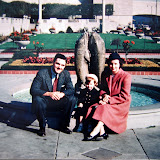 |
| Helen / Boppee |
Monday, November 10, 2008
Desmond Tutu on Obama
It is amazing when the people you hold up as heroes also are writing wondrous words about the man your country just elected as president. . .
Even if I don't always trust my own opinion, I do trust Mr. Tutu.
-------------------------------------------------------------------
The Man of Tomorrow
His election has turned America's global image on its head.
By Desmond Tutu
Sunday, November 9, 2008; Page B01
CAPE TOWN I am rubbing my eyes in disbelief and wonder. It can't be true that Barack Obama, the son of a Kenyan, is the next president of the United States.
But it is true, exhilaratingly true. An unbelievable turnaround. I want to jump and dance and shout, as I did after voting for the first time in my native South Africa on April 27, 1994.
We owe our glorious victory over the awfulness of apartheid in South Africa in large part to the support we received from the international community, including the United States, and we will always be deeply grateful. But for those of us who have looked to America for inspiration as we struggled for democracy and human rights, these past seven years have been lean ones.
A few days after the Sept. 11, 2001, terrorist attacks, we had our first shock, hearing your president respond not with the statesmanlike demeanor we had come to expect from a U.S. head of state but like a Western gunslinger. Later, it seemed that much of American society was following his lead.
When war began, first in Afghanistan and not long after in Iraq, we read allegations of prisoner abuse at Bagram air base in Afghanistan and of rendition to countries notorious for practicing torture. We saw the horrific images from Abu Ghraib and learned of gruesome acts performed in the name of gathering information. Sometimes the torture itself was couched in the government's euphemisms -- calling waterboarding an "interrogation technique."
To the outgoing administration's record on torture we must add a string of other policies that have damaged the standing of the United States in the world: its hostility to the Kyoto Protocol on greenhouse gases; its refusal to assent to the Rome Statute of the International Criminal Court, establishing the ICC's role in prosecuting war crimes; its restrictions on the use of U.S. funding to fight AIDS; and the arrogant unilateralism it has employed in declaring to be enemies any countries it deemed "against us" because they were not "for us."
The Bush administration has riled people everywhere. Its bully-boy attitude has sadly polarized our world.
Against all this, the election of Barack Obama has turned America's image on its head. My wife was crying with incredulity and joy as we watched a broadcast of the celebrations in Chicago. A newspaper here ran a picture of Obama from an earlier trip to one of our townships, where he was mobbed by youngsters. It was tacitly saying that we are proud he once visited us.
Today Africans walk taller than they did a week ago -- just as they did when Nelson Mandela became South Africa's first black president in 1994. Not only Africans, but people everywhere who have been the victims of discrimination at the hands of white Westerners, have a new pride in who they are. If a dark-skinned person can become the leader of the world's most powerful nation, what is to stop children everywhere from aiming for the stars? The fact that Obama's Kenyan grandfather was a convert to Islam may -- shamefully -- have been controversial in parts of the United States, but elsewhere in the world, Obama's multi-faith heritage is an inspiration.
And the president-elect has one additional key quality: He is not George W. Bush.
Because the Bush years have been disastrous for other parts of the world in many ways, Obama's victory dramatizes the self-correcting mechanism that epitomizes American democracy. Elsewhere, oppressors, tyrants and their lapdogs can say what they like, and they stay put, for the most part. Ordinary citizens living in undemocratic societies are not fools; they may not always agree with U.S. foreign policy, but they can see and register the difference between the United States, where people can kick an unpopular political party out, and their own countries.
In the midst of this celebration, however, a word of caution is appropriate. In the first days after 9/11, the United States had the world's sympathy, an unprecedented wave of it. President Bush squandered it. Obama could squander the goodwill that his election has generated if he does not move quickly and decisively on the international front.
On human rights, President Obama needs to signal the changes his administration will bring by speedily taking a few high-profile symbolic actions. One might be to close that abomination, the detention facility at Guantanamo Bay. Another could be immediate replacement of guidelines on the treatment of detainees, thus putting the United States back in the mainstream of international humanitarian law. He could launch a comprehensive inquiry into who authorized torture and when. And it would be wonderful if, on behalf of the nation, he would apologize to the world, and especially the Iraqis, for an invasion that I believe has turned out to be an unmitigated disaster.
On humanitarian issues, he will be hard-pressed in the ongoing global financial crisis to match the current administration's generally admirable record. President Bush has succeeded in working with Congress to devote unprecedented amounts of money to fighting malaria, tuberculosis and HIV/AIDS. But if the United States is to show that it places as much value on a human life in Africa as on one in the United States, Obama actually has to improve on Bush's achievements.
Obama's election has given Americans the message that hope is viable, that change is really possible. He galvanized huge numbers of his compatriots across the board, particularly young people who had become disillusioned with politics. He drew huge numbers of volunteers and raised record amounts of money, not just in donations from the wealthy but in relatively small amounts from many so-called ordinary people. Judging by the reception he received in Berlin earlier this year, he has given the world similar hope.
The renowned African scholar Ali Mazrui has pointed out that Obama could never have gotten as far as he has without an exceptional level of trust on the part of white Americans. In this, his achievement is similar to what Nelson Mandela had achieved by the end of his presidency; Mandela's party may never have drawn a majority of white votes, but he has come to be revered by white as well as black South Africans as the founding father of our democracy.
Mazrui likens Obama to Mandela in other ways, saying that both men share a readiness to forgive and show "a remarkable capacity to transcend historical racial divides." Both, Mazrui says, are "potential icons of a post-racial age which is unfolding before our eyes."
Such a post-racial age for me has the characteristics of a rainbow. We are in a different time now than when I first spoke of a rainbow nation, describing the South Africa that Mandela led for the first time in 1994. But my vision for such a place remains. It is a place where people of each race and cultural group exhibit their own unique identity, their own distinct attributes, but where the beauty of the whole gloriously exceeds the sum of its parts.
Obama is the son of a Kenyan man and a Kansan woman. He spoke movingly about his background during his long campaign. Now he's the president-elect. His triumph can help the world reach the point where we realize that we are all caught up in a delicate network of interdependence, unable to celebrate fully our own heritage and place in the world, unable to realize our full potential as human beings, unless everyone else, everywhere else, can do the same.
Desmond Tutu is the Archbishop Emeritus of Cape Town. He won the Nobel Peace Prize in 1984.
Even if I don't always trust my own opinion, I do trust Mr. Tutu.
-------------------------------------------------------------------
The Man of Tomorrow
His election has turned America's global image on its head.
By Desmond Tutu
Sunday, November 9, 2008; Page B01
CAPE TOWN I am rubbing my eyes in disbelief and wonder. It can't be true that Barack Obama, the son of a Kenyan, is the next president of the United States.
But it is true, exhilaratingly true. An unbelievable turnaround. I want to jump and dance and shout, as I did after voting for the first time in my native South Africa on April 27, 1994.
We owe our glorious victory over the awfulness of apartheid in South Africa in large part to the support we received from the international community, including the United States, and we will always be deeply grateful. But for those of us who have looked to America for inspiration as we struggled for democracy and human rights, these past seven years have been lean ones.
A few days after the Sept. 11, 2001, terrorist attacks, we had our first shock, hearing your president respond not with the statesmanlike demeanor we had come to expect from a U.S. head of state but like a Western gunslinger. Later, it seemed that much of American society was following his lead.
When war began, first in Afghanistan and not long after in Iraq, we read allegations of prisoner abuse at Bagram air base in Afghanistan and of rendition to countries notorious for practicing torture. We saw the horrific images from Abu Ghraib and learned of gruesome acts performed in the name of gathering information. Sometimes the torture itself was couched in the government's euphemisms -- calling waterboarding an "interrogation technique."
To the outgoing administration's record on torture we must add a string of other policies that have damaged the standing of the United States in the world: its hostility to the Kyoto Protocol on greenhouse gases; its refusal to assent to the Rome Statute of the International Criminal Court, establishing the ICC's role in prosecuting war crimes; its restrictions on the use of U.S. funding to fight AIDS; and the arrogant unilateralism it has employed in declaring to be enemies any countries it deemed "against us" because they were not "for us."
The Bush administration has riled people everywhere. Its bully-boy attitude has sadly polarized our world.
Against all this, the election of Barack Obama has turned America's image on its head. My wife was crying with incredulity and joy as we watched a broadcast of the celebrations in Chicago. A newspaper here ran a picture of Obama from an earlier trip to one of our townships, where he was mobbed by youngsters. It was tacitly saying that we are proud he once visited us.
Today Africans walk taller than they did a week ago -- just as they did when Nelson Mandela became South Africa's first black president in 1994. Not only Africans, but people everywhere who have been the victims of discrimination at the hands of white Westerners, have a new pride in who they are. If a dark-skinned person can become the leader of the world's most powerful nation, what is to stop children everywhere from aiming for the stars? The fact that Obama's Kenyan grandfather was a convert to Islam may -- shamefully -- have been controversial in parts of the United States, but elsewhere in the world, Obama's multi-faith heritage is an inspiration.
And the president-elect has one additional key quality: He is not George W. Bush.
Because the Bush years have been disastrous for other parts of the world in many ways, Obama's victory dramatizes the self-correcting mechanism that epitomizes American democracy. Elsewhere, oppressors, tyrants and their lapdogs can say what they like, and they stay put, for the most part. Ordinary citizens living in undemocratic societies are not fools; they may not always agree with U.S. foreign policy, but they can see and register the difference between the United States, where people can kick an unpopular political party out, and their own countries.
In the midst of this celebration, however, a word of caution is appropriate. In the first days after 9/11, the United States had the world's sympathy, an unprecedented wave of it. President Bush squandered it. Obama could squander the goodwill that his election has generated if he does not move quickly and decisively on the international front.
On human rights, President Obama needs to signal the changes his administration will bring by speedily taking a few high-profile symbolic actions. One might be to close that abomination, the detention facility at Guantanamo Bay. Another could be immediate replacement of guidelines on the treatment of detainees, thus putting the United States back in the mainstream of international humanitarian law. He could launch a comprehensive inquiry into who authorized torture and when. And it would be wonderful if, on behalf of the nation, he would apologize to the world, and especially the Iraqis, for an invasion that I believe has turned out to be an unmitigated disaster.
On humanitarian issues, he will be hard-pressed in the ongoing global financial crisis to match the current administration's generally admirable record. President Bush has succeeded in working with Congress to devote unprecedented amounts of money to fighting malaria, tuberculosis and HIV/AIDS. But if the United States is to show that it places as much value on a human life in Africa as on one in the United States, Obama actually has to improve on Bush's achievements.
Obama's election has given Americans the message that hope is viable, that change is really possible. He galvanized huge numbers of his compatriots across the board, particularly young people who had become disillusioned with politics. He drew huge numbers of volunteers and raised record amounts of money, not just in donations from the wealthy but in relatively small amounts from many so-called ordinary people. Judging by the reception he received in Berlin earlier this year, he has given the world similar hope.
The renowned African scholar Ali Mazrui has pointed out that Obama could never have gotten as far as he has without an exceptional level of trust on the part of white Americans. In this, his achievement is similar to what Nelson Mandela had achieved by the end of his presidency; Mandela's party may never have drawn a majority of white votes, but he has come to be revered by white as well as black South Africans as the founding father of our democracy.
Mazrui likens Obama to Mandela in other ways, saying that both men share a readiness to forgive and show "a remarkable capacity to transcend historical racial divides." Both, Mazrui says, are "potential icons of a post-racial age which is unfolding before our eyes."
Such a post-racial age for me has the characteristics of a rainbow. We are in a different time now than when I first spoke of a rainbow nation, describing the South Africa that Mandela led for the first time in 1994. But my vision for such a place remains. It is a place where people of each race and cultural group exhibit their own unique identity, their own distinct attributes, but where the beauty of the whole gloriously exceeds the sum of its parts.
Obama is the son of a Kenyan man and a Kansan woman. He spoke movingly about his background during his long campaign. Now he's the president-elect. His triumph can help the world reach the point where we realize that we are all caught up in a delicate network of interdependence, unable to celebrate fully our own heritage and place in the world, unable to realize our full potential as human beings, unless everyone else, everywhere else, can do the same.
Desmond Tutu is the Archbishop Emeritus of Cape Town. He won the Nobel Peace Prize in 1984.
Subscribe to:
Posts (Atom)


